Bring Your Bags
Reflections of a Fellow Traveler

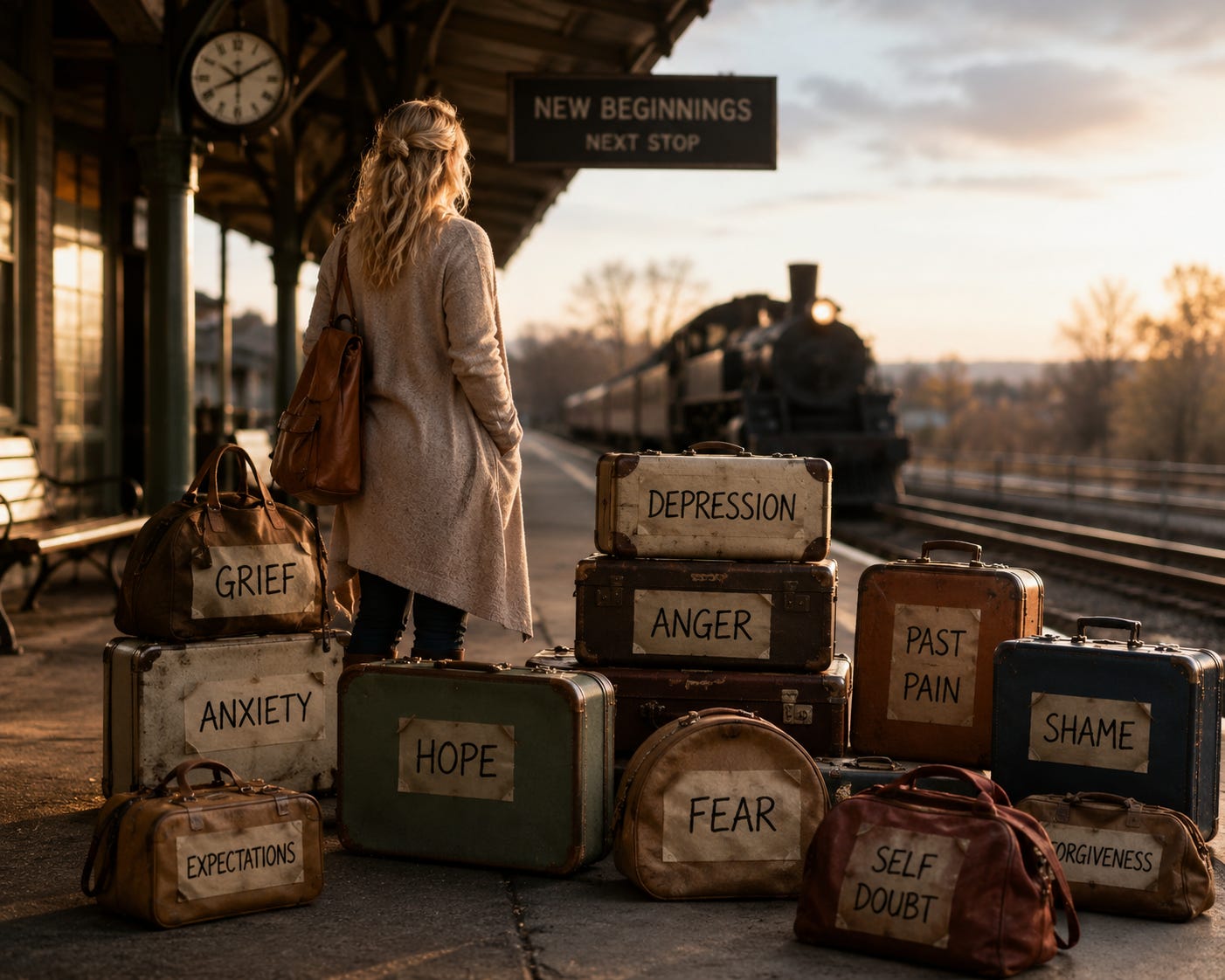
There is an image that has stayed with me for years.
A woman stands alone on a train platform. Around her are bags of every size—some small enough to carry in one hand, others so large they seem impossible to move. She isn’t running. She isn’t crying. She is simply standing there, surrounded by everything she has brought with her.
I don’t know why that image has never left me.
Perhaps it’s because, over the years, I have realized that many of us spend our lives standing on that same platform.
We carry grief.
We carry shame.
We carry responsibilities that were never ours.
We carry expectations we never agreed to.
We carry old wounds, broken dreams, fear of disappointing others, and the exhausting belief that everything somehow depends on us.
Sometimes we become so accustomed to the weight that we stop noticing we’re carrying it at all.
The bags simply become part of us.
Years ago, I read Max Lucado’s Traveling Light. His invitation to lay down the burdens we were never meant to carry has stayed with me ever since. Over the years, however, sitting with hundreds of people in the therapy room, I found myself thinking about that image a little differently.
If someone walked into my office carrying all of those bags, I wouldn’t ask them to throw them away.
I’d invite them to set them down for a while.
Not to abandon them.
Just long enough that we could look inside together.
Because before we can release what we’ve been carrying, we often need to understand it.
Where did this burden come from?
Who placed it there?
How long have you been carrying it?
Did it once protect you?
Did it help you survive?
There is grace in those questions.
As a therapist, I have learned that many of the things people desperately want to get rid of were once acts of survival.
Perfectionism.
Hypervigilance.
People-pleasing.
Emotional numbness.
Taking responsibility for everyone else’s feelings.
Those weren’t character flaws.
For many people, they were ingenious ways of making it through difficult seasons.
We don’t begin healing by shaming those adaptations.
We begin by honoring them.
We thank them for getting us here.
And then, gently, we ask,
“Do you still need to carry this?”
One by one, we begin opening the bags.
Some contain grief that has never been spoken aloud.
Some hold expectations handed to us by family, culture, or fear.
Some are filled with guilt that was never ours to own.
Some contain beautiful things—faith, resilience, compassion, wisdom—that deserve to be carried forward.
Healing isn’t throwing everything away.
Healing is learning what belongs and what does not.
As we sort through what is inside, something unexpected happens.
The person beneath the bags begins to emerge.
Not someone new! You...
The person God has been forming all along.
And then, for me, there is one final step.
After we have opened the bags.
After we have named what we’ve been carrying.
After we have grieved, processed, forgiven, and understood...
We don’t simply zip them back up and pick them up again.
We bring them to Christ.
Not because He is disappointed that we carried them.
But because He has been waiting, with open hands, to carry what we never could.
Perhaps that is what healing looks like.
Not pretending the bags were never heavy.
Not pretending they never mattered.
But finally trusting that we were never meant to carry them alone.
So, if you ever find yourself standing on that platform, surrounded by everything life has handed you...
Bring the bags.
We’ll set them down together.
We’ll open them gently.
We’ll honor what helped you survive.
We’ll grieve what never should have been there.
We’ll keep what belongs.
We’ll release what doesn’t.
And together, we’ll place the rest into the hands of the One who has been saying all along. Amen.
Perhaps today is the day you set the bags down—not because you’ve figured everything out, but because you no longer have to carry everything alone. Christ’s invitation has never been to pretend the burdens aren’t real. His invitation has always been to come. To rest. To trust that His grace is sufficient, His love is steadfast, and His hands are strong enough to carry what yours were never meant to hold. If you would like to read more about my therapeutic approach to healing, please reach out through my website Beach Counseling & Wellness Group of SC
Until next time, fellow traveler...
Grace and peace,
Michelle
Michelle Corey Colson, MA, MA, LPCA, D.Min. (Cand.)
Psychotherapist │ Christian Counselor │ Life Coach
Founder, Beach Counseling & Wellness Group of SC
Creator of The Grasoma Method™ – A Grace-Based Somatic Approach
“Walking beside you as a fellow traveler.”